

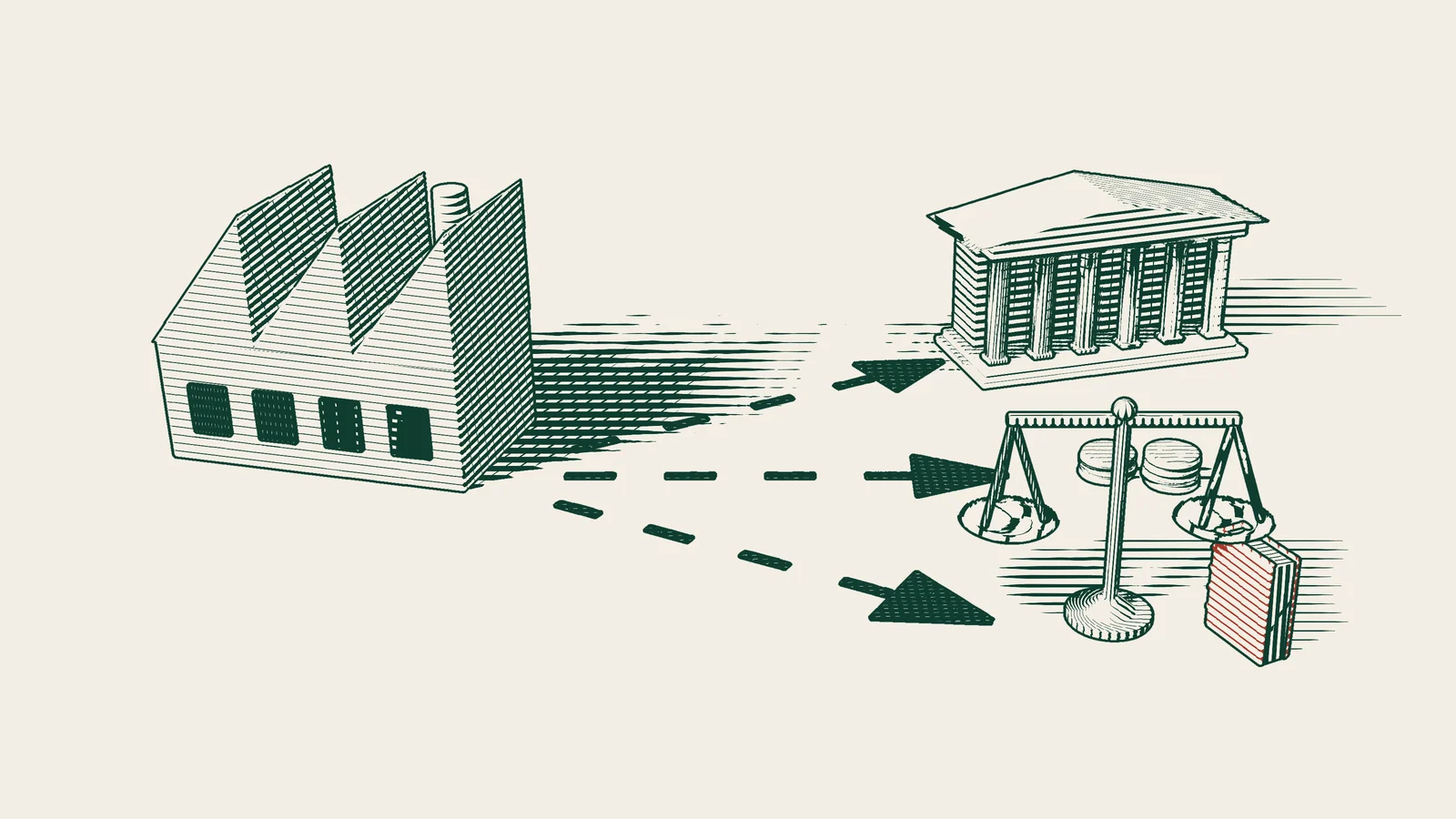
The notification duties that run in the first seventy-two hours shape all three, and the record the employer builds in week one is the record every later decision-maker reads.
A workplace accident in Türkiye does not produce one legal problem. It produces three separate proceedings that start at roughly the same moment and never merge: the Social Security Institution’s recourse claim under Article 21 of Law No. 5510, the administrative fines under Article 26 of the Occupational Health and Safety Act No. 6331, and a criminal investigation opened by the public prosecutor. A fourth exposure — the injured employee’s own compensation claim — sits behind them on a much longer clock.
The single most consequential fact for an employer is that all four are decided largely on documents that exist, or fail to exist, in the first week. The risk assessment in force on the day, the training records, the health surveillance file, the notification timestamps: these are assembled once and then read four times, by the labour inspector, by the Institution, by the prosecutor and by the labour court. What follows sets out each front, what actually triggers it, and where the statutory limits on employer exposure sit.

Which Notifications Must the Employer Make After an Accident?
Article 13 of Law No. 5510 defines a workplace accident and then imposes the reporting duty. For employees insured under Article 4(1)(a), the employer must notify the competent local law enforcement authority immediately and the Social Security Institution within three working days of the accident at the latest. Article 14(2)(a) of Law No. 6331 restates the three-working-day period as a health and safety obligation in its own right, which is why a single failure to report attracts consequences under two statutes.
One qualification in Article 13 does a great deal of practical work and is easy to miss because it sits in the paragraph after the deadline: where the accident occurs in a place outside the employer’s control, the period runs from the date the accident became known to the employer. For employers whose staff drive, visit sites or work at client premises, that sentence is the difference between a timely notification and a fine — but only if the file records when the employer actually learned of it.
The definition itself is broader than the intuitive one. Article 13 covers not only events while the insured person is at the workplace, but events during time spent away from the main job because the employer sent the employee elsewhere, and events during travel to and from the place of work in a vehicle provided by the employer. Employers hiring in Türkiye for the first time, a subject we cover in our guide to employing staff in Türkiye as a foreign employer, routinely underestimate the commuting limb.
| Duty | Source | Deadline | To whom |
|---|---|---|---|
| Notify the accident to law enforcement | Law No. 5510, Art. 13(2)(a) | Immediately | Competent local law enforcement authority |
| Notify the accident to the Institution | Law No. 5510, Art. 13(2)(a); Law No. 6331, Art. 14(2)(a) | 3 working days (from the day of knowledge where the place is outside the employer's control) | Social Security Institution |
| Keep records and draw up reports on all accidents and near-misses | Law No. 6331, Art. 14(1) | Ongoing | Held at the workplace |
| Renew the risk assessment after the event | Risk Assessment Regulation, Art. 12(2)(ç) | Triggered by the accident, near-miss or occupational disease | Held at the workplace |
| Report accidents reaching them | Law No. 6331, Art. 14(4) | 10 days | Health service providers, to the Institution |
The last row explains why silence is not a strategy. Even where the employer files nothing, hospitals and clinics are separately obliged to report accidents reaching them within ten days, so the event arrives at the Institution regardless — with the employer’s non-reporting already visible on the face of the file.
When Can the Social Security Institution Claim Its Payments Back?
Article 21 of Law No. 5510 is the provision that turns a social security payout into an employer liability. Where the accident arose from the employer’s intent, or from conduct contrary to legislation on protecting the health of insured persons and on occupational safety, the Institution recovers from the employer the payments made and to be made, together with the first capital value, as at the date it began, of any income awarded.

Two limits are written into the same paragraph, and both work in the employer’s favour:
- The recovery is capped at the amounts the insured person or the dependants could themselves claim from the employer. The recourse claim cannot outrun the underlying civil liability, which is why the fault apportionment matters as much here as it does in the compensation claim.
- The principle of unavoidability is taken into account in determining the employer’s responsibility. Where the court-appointed expert evidence establishes that a portion of the causation was unavoidable, that portion is not carried by the employer.
Article 21 also contains a discrete penalty for the reporting failure discussed above: where the accident is not notified within the Article 13 period, the temporary incapacity benefit for the period up to the date of notification is collected from the employer. That is a self-inflicted liability entirely independent of fault in the accident itself. Where a third party caused the accident, the fourth paragraph directs recourse against that third party — and against those who employ them, if they are at fault — for half the first capital value.
What Administrative Fines Follow Under Law No. 6331?
Article 26 of Law No. 6331 attaches a fixed fine to each substantive duty in the Act, separately: the general employer duties in Article 4(1)(a) and (b), the appointment of an occupational safety specialist and workplace physician of the required qualification under Article 6(1), the risk assessment under Article 10(1), the emergency plans, firefighting and first-aid duties in Article 11 and the evacuation duties in Article 12, the recording and notification duties under Article 14, health surveillance under Article 15, employee information under Article 16 and employee training under Article 17. After an accident the inspection tends to surface several of these at once, and they are cumulated rather than absorbed into a single penalty.
The amounts in the statute are the 2012 nominal figures. Under Article 17(7) of the Misdemeanours Act No. 5326 they are increased each calendar year by the revaluation rate, so the current-year figures have to be taken from the applicable annual notice rather than from the text of Article 26. Article 26(3) then adjusts them by workplace size and hazard class — unchanged, or increased by 25, 50, 100 or 200 per cent — with the important qualification in Article 26(5) that fines calculated by multiplying by the number of employees are not further adjusted under that scale. Article 26(4) adds that where work has been stopped, the fine for the act that caused the stoppage is not applied.
The procedural split is what most employers get wrong.
| Fines for the Article 14 notification failures | All other Article 26 fines | |
|---|---|---|
| Imposed by | The Social Security Institution, directly | The provincial director of the Labour and Employment Agency, with reasons |
| Procedure applied | Article 102 of Law No. 5510, by express reference in Art. 26(2) | General rules of the Misdemeanours Act No. 5326 |
| Challenge | Objection to the Institution within 15 days of notification; if rejected, application to the administrative court within 30 days | Application to the magistrate judge under Art. 27 of Law No. 5326 within 15 days of notification |
| Effect on collection | The objection to the Institution suspends enforcement; going to court does not | Governed by the general rules |
| Early payment | Paying within 15 days, before objecting or suing, means three-quarters is collected — and paying does not affect the right to go to court | Payment period is 30 days from notification (Art. 26(2)); a 25 per cent reduction applies on payment within the period under Art. 17(6) of Law No. 5326, without prejudice to the right of challenge |
The route follows a chain worth setting out, because Law No. 6331 does not name a court itself. Article 27(1) of Law No. 6331 applies the provisions of Labour Act No. 4857 that are not contrary to it where Law No. 6331 is silent; Article 108 of Law No. 4857 was rewritten with effect from 14 July 2025 and, in its current form, no longer prescribes a special appeal route; and Article 3(1)(a) of the Misdemeanours Act No. 5326 applies its own appeal provisions where other statutes contain no contrary provision. The general route therefore applies to the fines imposed by the provincial directorate. The two deadlines being both fifteen days is a coincidence, not a rule — the destinations differ, and so does what happens to collection in the meantime.
Article 25 sits alongside the fines rather than inside them. Where a matter creating a vital danger is identified, work is stopped until it is removed; in very hazardous mining, metal and construction work, work with hazardous chemicals and workplaces where major industrial accidents could occur, the mere absence of a risk assessment is itself a stoppage ground. Objection lies to the labour court within six working days, without suspensive effect, and the court decides within six working days. Working at a stopped site is not a fine matter at all: Article 25(8) provides for imprisonment of three to five years for the employer or employer’s representative who has unauthorised work carried out there. In mining specifically, Article 25/A adds a two-year public procurement ban where fault is established by a court decision after a fatal accident — a provision confined to mining workplaces and not a general rule.
How Does the Criminal File Proceed?
The criminal investigation is not something the employer applies for or avoids. Under Article 160 of the Criminal Procedure Code No. 5271, the public prosecutor begins investigating as soon as a situation giving the impression that an offence has been committed comes to their attention — and the immediate notification to law enforcement required by Article 13 of Law No. 5510 is normally the thing that brings it to their attention. Where there has been a death or an injury, the framing offences are negligent homicide under Article 85 and negligent injury under Article 89 of the Turkish Penal Code No. 5237.
Two structural points matter more for an employer than the tariff. The first is that the criminal file generates the fault report, and that report is then read across into the recourse claim and the compensation claim; evidence gathered casually in the first week is evidence used in all three. The second is that criminal responsibility in Turkish law attaches to natural persons, so the question of who within the organisation held which duty — the employer, the employer’s representative, the line supervisor, the occupational safety specialist — becomes decisive. That question is answered by the delegation documents, job descriptions and appointment records that either exist or do not.
Article 4 of Law No. 6331 closes the obvious escape route in advance. Receiving services from persons or organisations outside the workplace does not remove the employer’s responsibilities, and employees’ own health and safety obligations do not affect them. The Risk Assessment Regulation says the same from the other side: having carried out a risk assessment does not remove the obligation to ensure health and safety at the workplace.
Why Does the Employee’s Own Claim Outlast the Rest?
The compensation claim brought by the injured employee or, in a fatal case, by the dependants is the longest-running of the four. Article 417(2) of the Turkish Code of Obligations No. 6098 obliges the employer to take every measure necessary for occupational health and safety and to keep the necessary tools and equipment complete. Article 417(3) then does the decisive thing: compensation for damage connected with the employee’s death, harm to bodily integrity or violation of personality rights, arising from the employer’s conduct contrary to law or contract, is subject to the provisions on liability arising from breach of contract. The practical effect is that the claim carries the general ten-year limitation period in Article 146 rather than the shorter tort periods.
The heads of damage come from Articles 53 and 54 — funeral expenses, treatment costs, loss of earnings, loss of or reduction in working capacity, damage to economic prospects — with non-pecuniary compensation under Article 56, available to the relatives as well in cases of serious bodily harm or death. Article 55 governs the calculation, and its first paragraph contains a rule employers regularly assume the opposite of: social security payments that cannot be recovered, wholly or in part, and payments not made for the purpose of performance, are not taken into account in determining such damage and cannot be deducted from it. Income awarded by the Institution therefore does not simply cancel out the employer’s exposure. Article 55 was amended with effect from 31 July 2026 to regulate when statutory interest runs on the calculated sums and to require that amounts paid for the purpose of performance before the investigation stage be set off proportionally — a change worth checking against any payment made informally to a family in the weeks after an accident.
Where the relationship also ends, the accident claim and the termination claim travel together through the same procedural machinery, including the compulsory mediation stage described in our note on workplace mediation and labour litigation in Türkiye, and the litigation posture is the one set out on our workplace disputes and litigation page.
Why Is the First Week Decisive for the Employer?
Everything above converges on a single operational point. The documents that decide the recourse claim, the fines, the criminal file and the compensation claim are largely the same documents, and they are either in place on the day of the accident or they are not.
The risk assessment is the centre of gravity. Under the Risk Assessment Regulation it is renewed at most every two, four or six years in very hazardous, hazardous and less hazardous workplaces respectively — and, independently of that cycle, it must be renewed wholly or in part when a workplace accident, an occupational disease or a near-miss occurs. Its documentation has a prescribed minimum content: the workplace and employer details, the names and certificate details of those who carried it out, the date and the date of validity, the hazards and risks identified, the method used, the ranked analysis results and the corrective and preventive measures with their dates. The pages are initialled, the last page signed, and the document kept at the workplace.
Where subcontractors are involved, the chain has to be mapped rather than assumed. Article 2 of Labour Act No. 4857 makes the principal employer jointly liable towards the subcontractor’s employees for obligations arising from that Act, the employment contract or any collective agreement to which the subcontractor is a party. The Regulation adds that each subcontractor carries out its own risk assessment and gives a copy to the principal employer, who supervises those assessments, coordinates the work and integrates it with its own. A principal employer that cannot produce the subcontractor’s assessment is not merely missing a document; it is missing the evidence of the supervisory duty it was under.
None of this is exotic compliance. It is the ordinary content of the employer’s duty of care described in Article 4 of Law No. 6331 and Article 417 of the Code of Obligations, and it belongs in the standing employment framework covered on our labour law page rather than in an emergency response assembled after the event. Once an inspection, a recourse action and a criminal investigation are running at the same time, the defensive work of holding one consistent position across all three is described on our occupational safety compliance and post-accident employer representation page. The employers who come through the three fronts in reasonable shape are, almost without exception, the ones whose paperwork was already in order on the morning of the accident.




